Please click on the links below

Saturday, April 30, 2011

Friday, April 15, 2011
US embassy cables: A Gaddafi family portrait

US embassy cables: A Gaddafi family portrait
- guardian.co.uk,
- Article history
[ID:194957 Cable dated:2009-03-03T14:42:00]
C O N F I D E N T I A L SECTION 01 OF 03 TRIPOLI 000198
SIPDIS
DEPT PLEASE PASS TO COMMERCE FOR NATE MASON; STATE FOR NEA/MAG; PARIS FOR WALLER; LONDON FOR TSOU
E.O. 12958: DECL: 3/2/2019
TAGS: PGOV, ECON, EIND, EINV, ETRD, EAIR, LY
SUBJECT: BLACK SHEEP MADE GOOD? SAADI AL-QADHAFI'S EXPORT FREE ZONE IN WESTERN LIBYA
REF: 08 TRIPOLI 530
CLASSIFIED BY: Gene A. Cretz, Ambassador, U.S. Embassy - Tripoli, U.S. Dept of State.
REASON: 1.4 (b), (d)
1. (C) Summary: Saadi al-Qadhafi, son of Muammar al-Qadhafi, has recently turned his attention to transforming an area near the western Libyan town of Zuwara into an Export Free Trade Zone. The project would include an airport, immigration and customs operations, a high tech industrial park, banks, medical centers and educational facilities. During a rare visit by Muammar al-Qadhafi to Zuwara late last year, he promised to help bring the project to reality; work began a few days after the visit. As with most business ventures in Libya, there are considerable political dimensions to any economic enterprise. A desire to provide tangible deliverables to a leading city of the Berbers, with whom his regime has had a historically contentious relationship, may have helped prompt al-Qadhafi's support.
Saadi's status as a son of the first family may mean that his project stands a better chance of surviving as government budgets are tightened in light of flat oil prices. Although the Zuwara Free Trade Zone is an ambitious and expensive project, XXXXXXXXXXXX Regardless, the Berber-dominated town of Zuwara will benefit from the creation of new employment, both in the construction phase and later in the running of the zone.
End summary.
SAADI SETTLES IN
2. (C) Saadi al-Qadhafi, a son of Muammar al-Qadhafi, has recently spent considerable time in the predominantly Berber town of Zuwara, located in western Libya near the border with Tunisia. Saadi was married off several years ago to the daughter of prominent regime figure al-Khweildi al-Hmeidi XXXXXXXXXXXX According to residents, XXXXXXXXXXXX Saadi does his own shopping and walks the streets of Zuwara's small downtown area, usually with a small security detail. A former professional footballer (he enjoyed a single season with Perugia in Italy's Serie A league, owns a significant share of al-Ahli - one of the two biggest soccer teams in Libya - and has run Libya's Football Federation) and engineer by training, Saadi's focus has drifted from soccer to the military (he was briefly an officer in a special forces unit and reportedly did well, but was bored by military life) to movies (he owns the film production company World Navigator Entertainment). He now appears to be focused on developing Zuwara into an Export Free Zone.
ZUWARA PROJECT SIZEABLE IN SCOPE
3. (SBU) The Zuwara Export Free Trade Zone project was initiated in 2006 XXXXXXXXXXXX to develop the area located between the city of Zuwara and the fishing village of Ras-Ajdar. The latter is located on the Libya-Tunisia border.
The zone is intended to encourage foreign investment and prompt industrial and commercial development and tourism that will contribute to long-term economic growth. In a press release, Saadi highlighted the project as a means by which to diversify Libya's economy, reduce dependence on oil revenues, create jobs and strengthen foreign investment. The design of the project was assigned to a number of multinational companies, which have developed a phased plan for the project. In late 2008, Emirati Emaar Properties and the Government of Libya (GOL) created a joint venture company to be the main developer of Phase 1, which included developing residential, commercial, industrial, educational, healthcare, leisure and entertainment components designed to attract foreign investment and generate employment.
4. (SBU) If implemented, the Zuwara Export Free Trade Zone would be the first of its kind in Libya. It would have unique
TRIPOLI 00000198 002 OF 003
features such as its own harbor and airport, and immigration and customs offices to facilitate vistors' entry into Libya, and would be a fully-functioning hub for business investors. In a nod to cultural sensitivity, there would be multi-religious worship facilities in the zone and the area would deliberately cultivate "western style" business laws with which European and American companies would be familiar. Locally-engaged Embassy staff resident in Zuwara have heard credible reports that Saadi has secured agreement to sell alcohol in the zone as part of an effort to make it attractive to potential expatriate investors and business interests. (Note: Libya is technically dry, although there is a thriving black market for alcohol and discreet drinking is tacitly accepted. A number of new hotels in Tripoli due to open soon have requested liquor licenses and believe they may get them, although there is credible reporting suggesting that Muammar al-Qadhafi personally opposes the consumption of alcohol and will not allow it so long as he remains in power. End note.)
LEADER'S VISIT SPARKS MOVEMENT ON CONSTRUCTION
5. (C) During a rare visit by Muammar al-Qadhafi to Zuwara in September 2008, he promised to help bring the project to fruition. His visit and interest in the project may have been partly prompted by a desire to provide tangible deliverables to the Berber community, with which his regime has had a historically contentious relationship. In 2007, the GOL showed some evidence of reversing its longstanding denial that any Berber communities exist in Libya and granted permission to the Amazigh (Berber) World Congress to host a large gathering in Tripoli in August 2007. Saif al-Islam al-Qadhafi, son of Muammar al-Qadhafi, and the Prime Minister made high-profile visits in August and September 2007 to predominantly Berber communities and announced major infrastructure investments; however, in March 2008 the GOL hotly criticized a request for Emboffs to visit Berber leaders in Zuwara and in May 2008 Muammar al-Qadhafi denied the existence of an ethno-linguistically distinct Berber minority in a visit to Berber tribes near Jadu (reftel).
6. (C) Within a few days of his al-Qadhafi's visit to Zuwara, significant work on the free trade zone project began. On a site visit to Zwara in October 2008, Econoff noticed several old buildings being torn down along the beachfront to make way for new buildings. Roads have been re-surfaced in record time and the city's main entrance from the coastal road leading to Tripoli has been spruced up with palm trees and landscaping.
Local residents have remarked that their town, which had been a bit dusty and shabby, now looks like "an international city". A project to build another water desalination plant has just been awarded to a Turkish contractor and work has begun, which will directly contribute to the overall standard of living for Zuwara's residents. There is talk in the town of Zwara that the best building in town, previously owned by the National Livestock Company, will host the new joint venture company that will manage construction of the free zone.
7. (C) Comment: Saadi's status as a son of the first family likely means that the Zuwara Export Free Trade Zone stands a better chance of surviving as budgets are trimmed in light of flat oil prices. As reported previously, the GOL had initially pegged its 2009 national budget (now being debated at the session of the General People's Congress currently underway) to a price per barrel of USD 65; however, it recently re-calibrated the budget and significantly reduced outlays on some development projects to reflect sagging oil prices. Although the Zuwara Free Trade Zone is an ambitious and expensive project, Muammar al-Qadhafi likely views it as a relatively small price to pay if it helps occupy the notoriously ill-behaved Saadi and lend a patina of useful engagement to his otherwise less than sterling reputation. Saadi has a troubled past, including scuffles with police in Europe (especially Italy), abuse of drugs and alcohol, excessive partying, travel abroad in contravention of his father's wishes XXXXXXXXXXXX Creating the appearance of useful employment for al-Qadhafi's offspring has been an important objective for the regime. Muhammad al-Qadhafi (the oldest of al-Qadhafi's children, but by his first wife)
TRIPOLI 00000198 003 OF 003
dominates the telecommunciations sector, Saif al-Islam is the presumed heir-apparent and is focused on civil society and political-economic reform, Muatassim is National Security Adviser, Hannibal (another miscreant whose recent misbehavior in Geneva is the cause of the current rupture in Swiss-Libyan
relations) has maritime shipping, Khamis is commanding officer of Libya's premier military unit and Aisha runs a quasi-governmental organization and helps mediate family disputes. The mystery candidate is Saif al-Arab, who reportedly spends most of his time in Munich, where he is involved in ill-defined business pursuits and spends much of his time partying. Regardless of any desire to appease the Berber community and/or paternalistic motives behind the GOL's support for the free trade zone, the town of Zuwara and its predominantly Berber residents stand to benefit in the end from the project. End comment.
CRETZ
Thursday, April 14, 2011
WikiLeaks by David Leigh and Luke Harding - review
WikiLeaks by David Leigh and Luke Harding - review
A breach of secrecy that will never be repeated.
- The Guardian,
- Article history
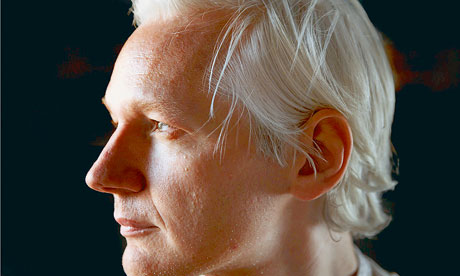
Julian Assange. Photograph: Linda Nylind/The Guardian
While travelling through Serbia in August 1991, the US secretary of state, James Baker, learned that Gorbachev had been overthrown – not from secret intelligence but from watching CNN. Similarly the first news of the terrorist outrage at Domodedovo airport in Moscow in January this year came to the Kremlin not from intelligence sources but from Twitter. Through technological progress the exclusive rights of the great powers to keep their most sensitive information secret appear to have been summarily withdrawn.
Hillary Clinton's diplomatic pillow talk is no longer privileged information, and her fury knows no limits. The man found to have been the ultimate culprit is kept naked in an American military facility with President Obama's explicit support. The recipient of a quarter of a million classified US documents and the purveyor of these indiscretions, Julian Assange, fears the possibility of extradition to the United States after indictment in Sweden for rape.
US Representative Peter King, once a notoriously firm and open backer of IRA terrorism but now chair of the homeland security committee, wants to designate WikiLeaks "a foreign terrorist organisation". Sarah Palin unthinkingly asserts that Assange has "blood on his hands". She argues that he should be pursued like the Taliban and al-Qaida (ie executed without trial). Yet even the Pentagon admits that there is no evidence that his revelations have resulted in bloodshed.
It is therefore worth asking why Assange has found widespread support for his actions. The prevalent mistrust of government, notably in the United States and Britain, did not appear from nowhere. It arose from the war in Iraq, the elaborate lies told to justify it and the lack of accountability of the Bush and Blair administrations to the broader public, whose soldiers died for the cause and whose purse paid for the venture.
And the US government itself is responsible for the insecure communication system that made release not just possible but inevitable. One wonders whether foreign intelligence services were not already purloining its contents for some time prior to the WikiLeaks revelations and are feeling even more aggrieved at Assange than Washington that the system is now terminated. Ironically it was due to the US government's determination to mobilise cyberspace to enhance security after 9/11 that WikiLeaks was able to expose American diplomacy across the board. If ever there were a good argument that when governments act ambitiously their results often bear no relation to their intentions, this is it.
Two of the three books under review – David Leigh and Luke Harding's WikiLeaks: Inside Julian Assange's War on Secrecy (Guardian Books, £9.99) and Daniel Domscheit-Berg's Inside WikiLeaks: My Time with Julian Assange at the World's Most Dangerous Website (Jonathan Cape, £9.99) – give us a breathless and informative narrative. The third, Micah Sifry's WikiLeaks and the Age of Transparency (Yale, £9.99), focuses instead on the politics from a high moral plane. Sifry's core point is that "If we promote the use of the internet to overturn repressive regimes around the world, then we have to either accept the fact that these same methods may be used against our own regime – or make sure our own policies are beyond reproach."
Domscheit-Berg, in contrast, relates the history of WikiLeaks as a disillusioned former assistant. It is unquestionably enlightening. But accounts of Assange "bumbling" with microphones, not washing his socks and acting the office dictator is what might appear in a nasty divorce case in a legal drama on TV. I am not convinced we need to know all this unless considering future employment at WikiLeaks or, worse still, sharing an apartment with the great man. Leigh and Harding, on the other hand, have no axe to grind and combine an objective history of events with sufficient personal illustration to be convincing.
That said, WikiLeaks might be, as they claim, the "biggest leak in history", but is it really the most important? Seymour Hersh wrote a whole book on Henry Kissinger based entirely on such leakage and Daniel Ellsberg got into hot water for leaking volumes of the Pentagon papers at a time when the war in Vietnam was still in progress. One should not forget Watergate, either.
And what exactly are the consequences of the WikiLeaks? At the present rate of release it will take over two decades to see all the documents. By then they would be released under the normal archival schedule. Second, the documents were at the lowest level of secrecy: confidential, not top secret. One can access confidential documents in some archives up to the very recent past (at the Brazilian Foreign Ministry, for instance).
Third, diplomats continue to write assessments that are indiscreet; otherwise what else would they do? Fourth, since the Americans are so powerful, however much they insult Putin or Berlusconi it will really make no significant difference to the state of relations with Russia or Italy. Far worse has been done in the past with no result. (And it is impossible to embarrass Berlusconi.)
These foreign statesmen themselves know very well that their own services spill the beans about their counterparts. It is a little embarrassing to have dirty linen washed in public, but no more than that. Politicians are, after all, focused on interests, not feelings. Moreover, the White House has as a result of the scandal rolled back on information sharing; so it is no longer possible to access confidential State Department communications via the military network. We are unlikely to see a repetition of these events.
Lastly, the state of trauma evidently suffered by Clinton will ensure less rather than more openness with respect to releasing diplomatic records in future. Her predecessor did not want anything released. Let us hope a more enlightened view will take hold and ultimately prevail.
Source:
Wednesday, April 13, 2011
Julian Assange claims WikiLeaks is more accountable than governments
Julian Assange claims WikiLeaks is more accountable than governments
WikiLeaks founder defends organisation in his first formal public appearance since being arrested over sexual assault allegations
- guardian.co.uk,
- Article history
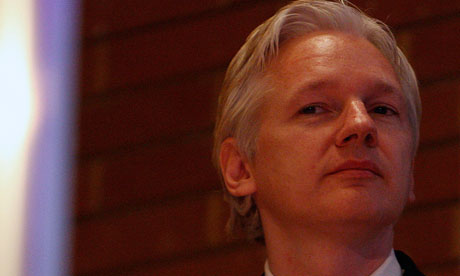
WikiLeaks 'is more responsive than a government that is elected after sourcing money from big business every four years,' Assange told the audience. Photograph: Akira Suemori/AP
WikiLeaks is more accountable than democratically elected governments because it accepts donations from members of the public, Julian Assange has claimed, in his first formal public appearance since being arrested in December following accusations of rape and sexual assault.
Questioned at a public debate about the whistleblowing organisation's own transparency, Assange told an audience of 700 people, many of them supporters: "We are directly supported on a week-to-week basis by you. You vote with your wallets every week if you believe that our work is worthwhile or not. If you believe we have erred, you do not support us. If you believe we need to be protected in our work, you keep us strong.
"That dynamic feedback, I say, is more responsive than a government that is elected after sourcing money from big business every four years."
The WikiLeaks founder, who is currently appealing against his extradition to Sweden to face allegations of sexual assault, told the audience at a packed debate organised by the New Statesman and the Frontline Club that whistleblowing was essential in a democracy because "the only way we can know whether information is legitimately kept secret is when it is revealed".
He cited the examples of Vietnam and "the disaster that was the Iraq war", saying that if whistleblowers had had the courage to speak up earlier about both conflicts, "bloodbaths" could have been avoided.
He said he "could speak for hours" about the impact of the publication of leaked US embassy cables, much of it through the Guardian, and that leak's positive impact.
The Hindu newspaper had in recent weeks published 21 front pages based on so-called "cablegate" revelations, he said, leading to the Indian government walking out four times and a growing anti-corruption movement in the country.
But the political commentator Douglas Murray, director of the centre for social cohesion, challenged Assange over the website's sources of funding, its staffing and connections with the Holocaust denier Israel Shamir, who has worked with the site.
"What gives you the right to decide what should be known or not? Governments are elected. You, Mr Assange are not."
Murray also challenged the WikiLeaks founder over an account in a book by Guardian writers David Leigh and Luke Harding, in which the authors quote him suggesting that if informants were to be killed following publication of the leaks, they "had it coming to them".
Assange repeated an earlier assertion that the website "is in the process of suing the Guardian" over the assertion, and asked if Murray would like to "join the queue" of organisations he was suing.
The Guardian has not received any notification of such action from WikiLeaks or its lawyers.
Jason Cowley, the editor of the New Statesman and chair of the debate, interjected to ask: "How can the great champion of open society be using our libel laws to challenge the press?"
The WikiLeaks founder was obliged to leave before responding to all the questions in order to comply with the curfew conditions of his bail.
WikiLeaks' lawyer Mark Stephens could not be reached for comment. Asked after the debate whether he could shed any light on the supposed legal action, WikiLeaks spokesman Kristin Hrafnsson said "not really".
SOURCE:
Assange praises Indian newspaper's use of WikiLeaks disclosures
Assange praises Indian newspaper's use of WikiLeaks disclosures
US embassy cables released by WikiLeaks have made a huge impact in India. The Hindu began running stories based on the cables on 15 March, resulting in 21 front page scoops.
The government has been rocked by some of the revelations, with calls for the prime minister, Manmohan Singh, to resign.
This followed disclosures about the alleged bribery of MPs during the July 2008 confidence vote, which the government survived by a slim majority.
The Hindu's editor-in-chief, N. Ram, says: "The cables we have worked on so far expose the venal and sordid underbelly of India, which is corrupt, non-transparent, and vulnerable to manipulation by the big powers, in particular the United States."
Last week, Ram interviewed WikiLeaks co-founder Julian Assange at the house in Norfolk where he is staying while on bail fighting extradition to Sweden and asked him how the coverage of the embassy cables in India compared with the impact of the original revelations in November last year in western newspapers.
Assange replied: "I am very encouraged by what's happened in India... there's a spectrum of publishing in India which I think eclipses that of The Guardian, Le Monde, Der Spiegel and the New York Times, and El Pais, which were our original partners, although some of them had also done some very fine work." He continued:
"This is something we have seen with some of our other regional partners in Latin America, like Peru and Costa Rica coming up before elections — that the local focus is able to really burrow into important details.
I am tempted to say, based upon my reading of The Hindu that it is in a position to report more freely than these other papers are in their respective countries.
That may be, I suspect, not just as a result of the strength of The Hindu but as a result of the weakness of the Indian federal government as a structure that is able to pull together patronage networks and suppress journalism as a whole in India.
While it's certainly true that each one of the factions involved in Indian national politics is able to exert pressures, I think it is encouraging that India as a whole has not turned into one central pyramid of patronage, which is something we do see a bit in other countries like the United States."
Source:
Subscribe to:
Posts (Atom)